Non-Resident License Prices — All 50 States
| State ↕ | Non-Res Annual ↕ | Non-Res 1-Day ↕ | Non-Res 7-Day ↕ |
|---|
What Does an Out-of-State Fishing License Cost?
Non-resident fishing licenses cost significantly more than resident licenses in every state — typically 2 to 5 times the resident price. That premium exists because states fund fishery management through license fees, and residents who pay local taxes already contribute to that infrastructure. As a visiting angler, you're still required to purchase the license for any state where you fish.
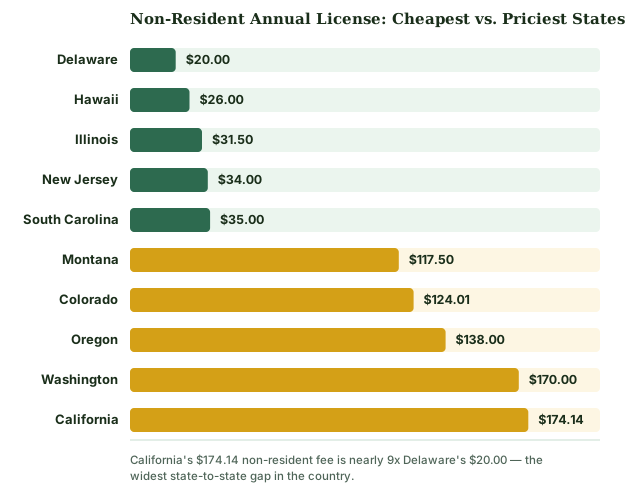
The range is wide. Delaware has the cheapest non-resident annual license in the country at just $20.00. At the other end, California's non-resident license runs $174.14 — the most expensive in the nation, just ahead of Washington's $170.00 combination license. Most states fall in the $40–$70 range for annual non-resident coverage.
One piece of good news for day-trippers: many states offer short-term licenses that are far more affordable than annual coverage. If you're visiting a state for a weekend or a single fishing trip, a 1-day or 7-day license often makes more financial sense than paying full annual price.
Top 5 Cheapest Non-Resident Fishing Licenses
| # | State | Non-Res Annual | Notes |
|---|---|---|---|
| 1 | Delaware | $20.00 | Lowest non-resident price in the country |
| 2 | Hawaii | $25.00 | Freshwater only |
| 3 | Illinois | $31.50 | Central location, easy access |
| 4 | New Jersey | $34.00 | Saltwater fishing is free statewide |
| 5 | South Carolina | $35.00 | Freshwater only — saltwater non-res is $75 |
When a 1-Day License Beats an Annual
If you're visiting a state for just one or two fishing trips per year, the math often favors a 1-day license over an annual. A day license in many states runs $7–$15. An annual non-resident license in those same states might be $50–$100. If you're making one trip per year, the annual is never worth it — and the 1-day option saves you money every time.
The calculus changes if you visit multiple times per year. Two or three trips to the same state and the annual license usually pays for itself. The Trip Planner on the main calculator lets you run the math on any multi-state scenario in seconds.
Do I Need a License in Every State I Fish?
Yes. Each state requires its own valid fishing license. There is no national fishing license or multi-state pass for recreational freshwater fishing. The only exceptions are reciprocal agreements between specific bordering states — for example, anglers fishing the boundary waters between certain states (like the Delaware River between Pennsylvania and New Jersey) may be covered by one state's license while on the water.
Non-Resident Fishing License — FAQs
Is there a national fishing license that covers all states?
No. There is no single national fishing license for recreational freshwater fishing. Each state manages its own license system. Federal fishing licenses do exist for saltwater fishing in federal waters (through the MRIP program), but freshwater and most coastal recreational fishing requires a state-issued license for the state where you're fishing.
Can I buy a non-resident fishing license online?
Yes. Every state allows non-residents to purchase licenses online through the state's wildlife agency website. Licenses are typically issued instantly and can be displayed on your phone. No physical card is required in most states. Links to each state's purchase page are available in the main calculator at the top of this site.
Which state has the cheapest non-resident fishing license?
As of 2026, Delaware has the cheapest non-resident annual fishing license at $20.00, followed by Hawaii at $25.00 (freshwater only) and Illinois at $31.50. For 1-day non-resident licenses, Utah ($9.00) and New Mexico ($12.00) are among the most affordable for single-day visitors.
Do I need a non-resident license if I'm just watching someone fish?
No license is required just to watch. You only need a license if you're actively fishing — meaning you have a line in the water or are actively attempting to catch fish. If you're on a chartered fishing boat, the charter may hold a license that covers passengers, so ask before buying your own.
Are non-resident fishing licenses valid for both freshwater and saltwater?
It depends on the state. Some states (like Texas) include both freshwater and saltwater in one license. Others (like Florida) sell them separately. Always check the specific state's requirements before you go. The main calculator includes notes for states with separate saltwater requirements.
What's the most expensive state for non-resident anglers?
California charges non-residents $174.14 for its annual sport fishing license — the highest in the country. Washington is second at $170.00 for its combination license, and Oregon is third at $138.00, largely due to the required Combined Angling Tag for salmon, steelhead, sturgeon, and halibut. All three are famous for exceptional fishing, but the cost is a real consideration for occasional visitors.