Lifetime License Break-Even Calculator
When Does a Lifetime Fishing License Make Sense?
A lifetime fishing license is a one-time purchase that replaces the annual license you'd otherwise buy every year. The math is simple on the surface — but fee inflation, the age you start fishing, and how consistently you fish all affect whether the lifetime option actually saves you money.
The calculator above accounts for annual fee increases (historically around 2–4% per year for most states). This matters because a $25 annual fee today will be closer to $45 in 20 years if fees rise at 3% annually. The lifetime license protects you from that creep entirely — once you pay, you're done forever.
The sweet spot for a lifetime license is typically someone who is under 40, lives in a state with a high annual fee, and fishes consistently every year. A 30-year-old in a state with a $45 annual fee might break even in 8–12 years. A 60-year-old doing the same math might never break even in their fishing lifetime.
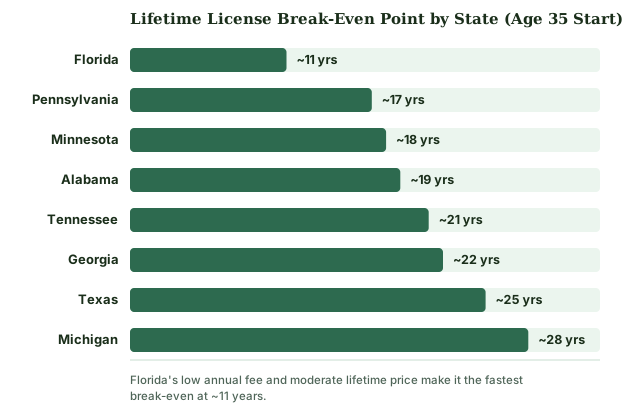
Lifetime Fishing License Costs by State — Reference Table
Approximate 2026 lifetime license costs for residents. Not all states offer lifetime licenses — check your state wildlife agency directly.
| State | Annual License | Approx. Lifetime Cost | Est. Break-Even (Age 35) |
|---|---|---|---|
| Alabama | $16 | ~$350 | ~19 years (age 54) |
| Florida | $17 | ~$200 | ~11 years (age 46) |
| Texas | $30 | ~$1,000 (super combo) | ~25 years (age 60) |
| Georgia | $15 | ~$400 | ~22 years (age 57) |
| Michigan | $26 | ~$850 | ~28 years (age 63) |
| Minnesota | $25 | ~$519 | ~18 years (age 53) |
| Pennsylvania | $27.97 | ~$600 | ~17 years (age 52) |
| Tennessee | $33 | ~$800 | ~21 years (age 56) |
Break-even estimates assume 3% annual fee inflation and fishing every year starting at age 35. Actual lifetime license costs vary — verify with your state wildlife agency.
The Hidden Benefit Nobody Talks About
Beyond the math, there's a behavioral benefit to a lifetime license: you fish more. Anecdotally, anglers who own lifetime licenses report that they're more likely to go out for an unplanned afternoon session, take the kids fishing on a whim, or make last-minute weekend trips — because the license friction is already gone. Annual license holders sometimes skip trips because they're "not sure it's worth renewing this year." Lifetime holders never face that hesitation.
Which States Have the Best Lifetime License Value?
States with high annual fees (Oregon at $50, Nevada at $40, Colorado at $44.87) but moderate lifetime costs offer the best financial returns. States with very cheap annual licenses (Hawaii at $6, Delaware at $8.50) have correspondingly poor break-even math — you'd have to fish for 30+ years to recoup the lifetime purchase price.
Lifetime Fishing License — FAQs
Do all states offer lifetime fishing licenses?
No. Not all states offer lifetime fishing licenses. The states that do typically sell them through their state wildlife agency, either as standalone fishing licenses or as bundled sport licenses that include hunting. Before purchasing, verify availability directly with your state agency — some states restrict lifetime licenses to residents only, and a few offer them at different age tiers (e.g., lower cost if purchased at birth).
Is a lifetime fishing license valid if I move to another state?
No. A lifetime fishing license is tied to your residency in the issuing state. If you move out of state, you lose the benefit of that license — you'd need to buy a non-resident annual license in your new state, or eventually qualify for residency there and purchase a new resident lifetime license. This is an important consideration for anyone who may relocate in the future.
Can I buy a lifetime license for my child?
Yes — and it's often the best lifetime license investment you can make. Many states offer discounted lifetime licenses for children, sometimes at a fraction of the adult price. A lifetime license purchased at birth or age 5 could provide 70+ years of fishing coverage at a fraction of what annual licenses would cost over that span. Check your state wildlife agency for youth lifetime license pricing.
What happens if license fees are lowered after I buy a lifetime license?
You keep the lifetime license regardless of price changes. In practice, state fishing license fees have historically increased over time, not decreased — so the break-even math improves the longer you hold the license. Fee decreases are extremely rare and typically only happen through targeted political action.
Does a lifetime license cover all types of fishing?
It depends on the state. Some lifetime licenses cover all freshwater and saltwater fishing. Others cover only the base license and still require add-on stamps or endorsements (like a trout stamp or a salmon tag). Always read the fine print when purchasing — the most expensive lifetime license packages typically offer the most comprehensive coverage.
Is the lifetime license transferred if I pass away?
No. Lifetime fishing licenses are non-transferable and are tied to the individual licensee. They cannot be transferred, sold, or inherited. Some states have provisions for refunds in specific circumstances, but these are rare. The license simply becomes void upon the holder's death.